
The RRB Station Master Syllabus 2026 is now a standalone 100-mark, 120-minute Computer Based Test (CBT), followed by a Computer Based Aptitude Test (CBAT). From 2026 onwards, recruitment to the post of Station Master will be notified separately through its own Centralised Employment Notification (CEN).
RRB Station Master 2026: Key Highlights
If you are preparing for the RRB Station Master exam, this article covers the new exam pattern, the full section-wise syllabus, the selection process and eligibility.
| Particular | Details |
|---|---|
| Conducting body | Railway Recruitment Boards (RRBs) |
| Post | Station Master |
| Notification | Separate CEN from 2026 onwards |
| Exam stages | Single Stage CBT → CBAT → Document Verification → Medical |
| CBT marks | 100 |
| CBT duration | 120 minutes |
| CBT sections | Basic Science, Mathematical & Analytical Capability (60), Logical Capability (20), Mental Reasoning (20) |
| Final merit | 70% CBT + 30% CBAT |
| Qualification | Graduation from a recognised university |
| Age limit | 20–33 years |
| Pay level | Level 6, 7th CPC (Basic pay ₹35,400) |
Also Read:
- ➤WBPSC Clerkship Exam Scheme & Syllabus 2026
- ➤APPSC AEE Syllabus 2026: Complete Syllabus, Exam Pattern and Preparation Guide
- ➤RRB NTPC Undergraduate Syllabus & Exam Pattern 2026: Post-Wise Guide with Detailed Analysis
- ➤UPSC EPFO APFC Syllabus and Exam Pattern 2026 for Assistant Provident Fund Commissioner Posts
RRB Station Master Major Changes 2026: Old Rules vs New Rules
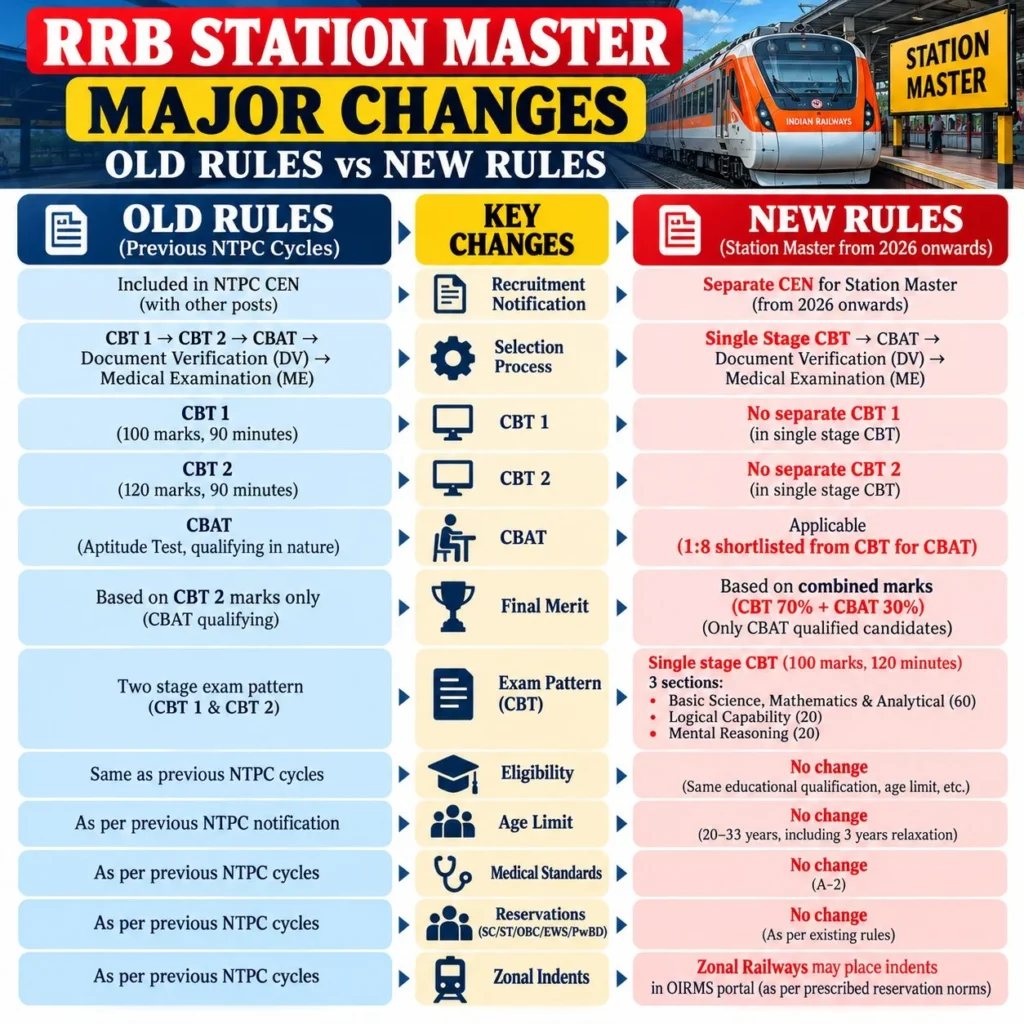
The biggest change is that Station Master now has its own recruitment notification. From the 2026 cycle, the Railway Board has decided to notify Station Master vacancies separately.
The main changes are:
- Separate CEN: A dedicated Centralised Employment Notification for Station Master.
- Single stage CBT: One 100-mark CBT, followed by a CBAT.
- New syllabus: A revised syllabus with a strong focus on science, maths, data analysis and reasoning. It applies from the 2026 Station Master CEN.
- Combined merit: Final selection uses 70% weightage for the CBT and 30% for the CBAT.
- RRB-wise shortlisting: Candidates are shortlisted separately for each RRB.
The infographic below shows the major changes in the RRB Station Master recruitment process at a glance, comparing the old rules with the new rules from 2026 onwards.
What Changed for RRB Station Master in 2026?
The biggest change is that Station Master now has its own recruitment notification. From the 2026 cycle, the Railway Board has decided to notify Station Master vacancies separately.
The main changes are:
- Separate CEN: A dedicated Centralised Employment Notification for Station Master.
- Single stage CBT: One 100-mark CBT, followed by a CBAT.
- New syllabus: A revised syllabus with a strong focus on science, maths, data analysis and reasoning. It applies from the 2026 Station Master CEN.
- Combined merit: Final selection uses 70% weightage for the CBT and 30% for the CBAT.
- RRB-wise shortlisting: Candidates are shortlisted separately for each RRB.
RRB Station Master Selection Process 2026
The RRB Station Master selection process has four stages. Each stage filters candidates RRB-wise.
- Single Stage CBT: A 100-mark objective test. Your rank here decides whether you reach the CBAT.
- Computer Based Aptitude Test (CBAT): Candidates up to 8 times the number of vacancies (RRB-wise) are shortlisted from the CBT merit list. You must pass the CBAT to stay in the race.
- Document Verification (DV): Candidates are called in a 1:1 ratio to vacancies for each RRB, based on combined CBT and CBAT merit.
- Medical Examination: Candidates must meet the A-2 medical standard.
How the Final Merit Is Calculated
The final merit list combines both computer-based tests:
- CBT score: 70% weightage
- CBAT score: 30% weightage
Only candidates who pass the CBAT are considered for the combined merit. A strong CBT score therefore carries most of the weight, but failing the CBAT ends your candidature.
RRB Station Master Exam Pattern 2026
The RRB Station Master CBT carries 100 marks and lasts 120 minutes. It has three components, with Basic Science, Mathematical and Analytical Capability carrying 60% of the paper.
| Component | Sub-section | Marks |
|---|---|---|
| 1. Basic Science, Mathematical & Analytical Capability | a. Basic Science and Mathematics | 30 |
| b. Data Analysis & Interpretation | 30 | |
| 2. Logical Capability | a. Logical Reasoning + b. Reading Comprehension | 20 |
| 3. Mental Reasoning | Analogy, Series, Coding-Decoding, Ranking & Arrangement | 20 |
| Total | 100 |
Duration: 120 minutes
RRB Station Master Syllabus 2026: Detailed Topic List
The revised syllabus below is taken from Annexure-A of the Railway Board letter. It will be used from the 2026 Station Master CEN.
1. Basic Science, Mathematical and Analytical Capability (60 Marks)
a. Basic Science and Mathematics (30 Marks)
Mathematics topics:
- Number System
- Ratio and Proportion
- Averages
- Percentages
- Profit, Loss and Discount
- Time, Speed and Distance
- Power and Work
- Algebra and Linear Equations
- Arithmetic Progression
- LCM and HCF
- Geometry and Trigonometry
- Area and Volumes
- Probability and Statistics (basic level only)
Basic Science topics:
- Units and Measurements
- Mass, Weight and Density
- Work, Power and Energy
- Kinetic Energy
- Friction
- Speed, Velocity and Relative Velocity
- Heat and Temperature
- Basic Electricity
- Levers and Simple Machines
b. Data Analysis and Interpretation (30 Marks)
This section tests multi-source data analysis. You will examine, analyse and draw inferences from text, tables and graphical data.
- Charts and graphs
- Scatter plots
- Pie charts
- Statistical curve distribution
- Venn diagrams
- Data Sufficiency
- Data Arrangement
2. Logical Capability (20 Marks)
a. Logical Reasoning
- Binary Logic
- Syllogism
- Clocks and Calendars
- Assumptions
- Blood Relations and Family Tree
- Logic-based puzzles
b. Reading Comprehension
Passages will be in English. Topics may come from History, Society, Literature, Science, Environment, Abstract subjects, Mythology, Technology and Culture.
Questions will test your understanding of:
- The main idea
- Supporting ideas
- Application of the idea
- Logical structure and style of the paragraph
3. Mental Reasoning (20 Marks)
- Analogy: Find the relationship between two items and apply it to another pair.
- Series Completion: Spot the pattern in a number sequence and predict the next term.
- Coding-Decoding
- Ranking and Arrangement problems
Also Read: SSB Odisha Lab Assistant Recruitment 2026, Apply Online for 435 Vacancies from 12 October
RRB Station Master Eligibility, Medical Standard and Salary
You need a graduation degree and must be 20 to 33 years old to apply for RRB Station Master. Other qualifying conditions and reservation rules follow the existing railway instructions for the post.
| Criteria | Requirement |
|---|---|
| Age limit (normal course) | 20–33 years, including a 3-year relaxation under Board’s letter No. E(NG)-II/94/RR-1/29/Pt. (3246807) dated 21.02.2018 |
| Educational qualification | Graduation degree from a recognised university, or equivalent |
| Medical standard | A-2 |
| PwBD suitability | Not suitable for VI, HI, LD, OD or MD categories |
| Pay level (7th CPC) | Level 6, basic pay ₹35,400 |
Frequently Asked Questions (FAQs)
Q1. What is the new RRB Station Master syllabus for 2026?
The 2026 syllabus has three parts: Basic Science, Mathematical and Analytical Capability (60 marks), Logical Capability (20 marks) and Mental Reasoning (20 marks).
Q2. Will RRB Station Master be notified separately?
Yes. From 2026 onwards, Station Master will be recruited through a separate CEN.
Q3. How many marks is the RRB Station Master CBT?
The single stage CBT is for 100 marks with a duration of 120 minutes.
Q4. Is there a CBAT for RRB Station Master?
Yes. Candidates up to 8 times the vacancies (RRB-wise) are shortlisted for the CBAT based on CBT merit. Passing the CBAT is mandatory.
Q5. How is the final merit list prepared?
Final merit uses 70% weightage for the CBT and 30% for the CBAT.
Q6. What is the age limit for RRB Station Master 2026?
The age limit in normal course is 20 to 33 years.