
ChatGPT, DeepSeek & Gemini tested on real SSC, UPSC and Bank exam questions. Honest scoring on accuracy, cost & ease of use — find your best AI tutor.
If you’re prepping for SSC CGL, Bank PO, Railways, or UPSC and you’ve been asking an AI chatbot to explain a quant question or check your essay, you already know the dirty secret: none of these tools were built for the Indian government exam syllabus. They were built to be general-purpose assistants. Whether they help you or waste your revision time depends entirely on what you’re testing them on and how much you’re willing to pay.
This isn’t a “which AI is smartest” piece. It’s a “which one should be open in your second tab while you’re solving a mock test” piece. I ran the three biggest names — ChatGPT (GPT-5.5/5.6 family), DeepSeek (V4 Flash/Pro), and Gemini (3.1 Pro) — through the same drill every aspirant actually does: a quant problem, a reasoning puzzle, and an essay prompt. Then I scored them the way you’d score a coaching institute, not a tech demo.
The Scoring Matrix
Before the test results, here’s what each platform actually costs and offers as of August 2026, since that changes constantly and most “AI comparison” articles online are quietly out of date.
| Metric | ChatGPT (Plus, $20/mo) | DeepSeek (Free web + cheap API) | Gemini (AI Pro, $19.99/mo) |
|---|---|---|---|
| Accuracy on structured problems | Strong, occasionally over-explains | Very strong on math/logic, terse | Strong, best at holding long context accurately |
| Cost for a student | ₹1,600+/month for full features | Free web chat; API is near-zero cost | ₹1,600+/month, free tier usable but capped |
| Context window | 128K on Plus (32K non-reasoning on Free) | 1M tokens on every tier, including free API | 1M tokens on Pro, 1M even on the free app tier |
| Ease of use for exam prep | Cleanest UI, best step-by-step formatting | Functional but plainer interface, less hand-holding | Tight integration with Docs/Search, good for research-heavy essay work |
Reality check on cost: DeepSeek’s free web chat and dirt-cheap API ($0.14 per million input tokens on V4 Flash) make it the only one of the three you can hammer with hundreds of practice questions a day without thinking about the bill. ChatGPT and Gemini both want ₹1,600–2,000/month for the tier that won’t throttle you mid-prep. If you’re an aspirant on a coaching-institute budget, that’s not a small detail — that’s half your monthly test-series budget.
Test 1: Math (Quantitative Aptitude)
The question (typical SSC CGL Tier-1 / Bank PO level):
A shopkeeper marks his goods 40% above cost price and allows a discount of 25% on the marked price. What is his profit or loss percentage?
This is a classic trap question — the kind that eats 90 seconds off your clock if you set it up wrong.
- ChatGPT: Set CP = 100, MP = 140, SP after 25% discount = 105. Correctly landed on 5% profit, and laid out the working in four clean lines. No errors, but it added a paragraph explaining why the shortcut formula works, which is useful once, annoying on your 50th question.
- DeepSeek: Same correct answer, 5% profit, but got there in the fewest lines of any of the three and even offered the direct formula (Profit% = MP(1-d) – CP, all over CP) so you can plug in numbers for the next ten questions without re-deriving it. This is the one that actually behaves like a drilling partner rather than a teacher.
- Gemini: Also correct, 5% profit, and it was the only one to flag that the “40% above cost, 25% off marked price” pattern shows up almost every year in SSC papers with different numbers — a genuinely useful pattern-recognition note, not just an answer.
Verdict on math: All three got it right. DeepSeek was fastest to a reusable method, Gemini added the best exam-pattern context, ChatGPT was the most “teacherly” but slowest to the point. For pure volume-solving (the thing you actually need for quant sections), DeepSeek wins on speed and cost.
Also Read: How AI Can Impact Your Competitive Preparation and Why It Matters
Test 2: Reasoning (Logical/Analytical)
The question (typical Bank/SSC reasoning set):
In a certain code, “TRAIN” is written as “USBJO”. How is “PLANE” written in the same code?
This tests whether the model can correctly identify the letter-shift pattern (each letter +1) rather than pattern-matching to something that looks plausible.
- ChatGPT: Correctly identified +1 shift per letter and produced “QMBOF.” Explained the shift clearly, letter by letter, which is genuinely helpful for a first-time learner but slow if you already know the concept and just want the answer verified.
- DeepSeek: Correct answer, “QMBOF,” delivered almost instantly with the letter mapping in a compact table. No fluff. This is where DeepSeek’s terseness stops being a downside and becomes exactly what you want — you’re checking your own working, not reading a lecture.
- Gemini: Correct answer, and it additionally flagged the two most common variations of this question type (reverse alphabet coding, and skip-one coding) that examiners use to trip up students who memorize the pattern instead of understanding it. Genuinely the most “exam-aware” response of the three.
Verdict on reasoning: All three nailed it — reasoning-type letter/number coding is not where these models fail. The differentiator is how much scaffolding you want. DeepSeek for drilling, Gemini for understanding traps, ChatGPT sits comfortably in the middle.
Also Read: How to Clear IBPS and SBI Clerk Exams Using AI (Without Buying Paid Batches)?
Test 3: Essay Writing
The prompt (UPSC Mains-style):
“India’s demographic dividend will remain a liability unless matched by employability.” Discuss in 250 words.
This is the real stress test. Anyone can solve a coded-letters puzzle. Writing a UPSC-grade essay — balanced, evidence-backed, structured, and inside a strict word limit — is a different skill entirely, and it’s where the three tools actually diverged.
- ChatGPT: Produced the most exam-ready structure out of the box: a clear thesis in the opening lines, three body paragraphs (skills gap, informal sector overload, policy response), and a forward-looking conclusion. Word count landed at 248, almost exactly on target. Its weakness: the language occasionally slipped into generic “AI-essay” phrasing that a UPSC evaluator would recognize as templated (a lot of “multifaceted,” “holistic approach,” “twin engines of growth” type filler).
- DeepSeek: Structurally sound but noticeably thinner on specific data points — it referenced the demographic dividend concept correctly but didn’t anchor claims to any concrete figures (skilling programs, labour force participation rate, etc.) the way a strong UPSC answer should. Good bones, needs the aspirant to add the substance.
- Gemini: The strongest essay of the three, and it’s not close. It pulled in more specific, checkable reference points (skill-development scheme names, sectoral employment trends) and structured the argument with an actual counter-argument paragraph before the conclusion — the “discuss both sides” move that UPSC examiners specifically reward. It also respected the 250-word limit most precisely.
Verdict on essays: Gemini is the clear winner here, and it’s not a fluke — its training and grounding tend to favor answers with more specific, sourced-feeling content, which matters enormously for UPSC Mains and essay-heavy state PSC exams. ChatGPT is a close second and arguably easier to iterate with conversationally. DeepSeek is fine for structure practice but you’ll need to fact-check and flesh it out yourself.
Pros and Cons
| Pros | Cons | |
|---|---|---|
| ChatGPT | Best step-by-step teaching style; cleanest interface; strong at explaining why, not just what; good at iterative essay editing | Costs the most for the reliable tier; free tier context window is small (16–32K tokens) and easy to hit mid-session; can be verbose when you just want a fast answer |
| DeepSeek | Free web chat with no meaningful cap; near-free API for building your own drilling tool; terse, fast answers ideal for high-volume quant/reasoning practice; huge 1M-token context even for free | Essays and long-form answers lack depth and specific data unless you push it hard with follow-ups; interface is more bare-bones; less “exam-aware” framing unless prompted |
| Gemini | Best essay and long-context performance; genuinely useful exam-pattern awareness baked into answers; 1M-token context even on the free tier is enormous for pasting entire syllabi or PYQ sets; tight Google Search/Docs integration for research | Free tier usage limits can bite during heavy daily use; Pro tier is priced the same as ChatGPT Plus; occasionally over-hedges on politically or socially sensitive essay topics |
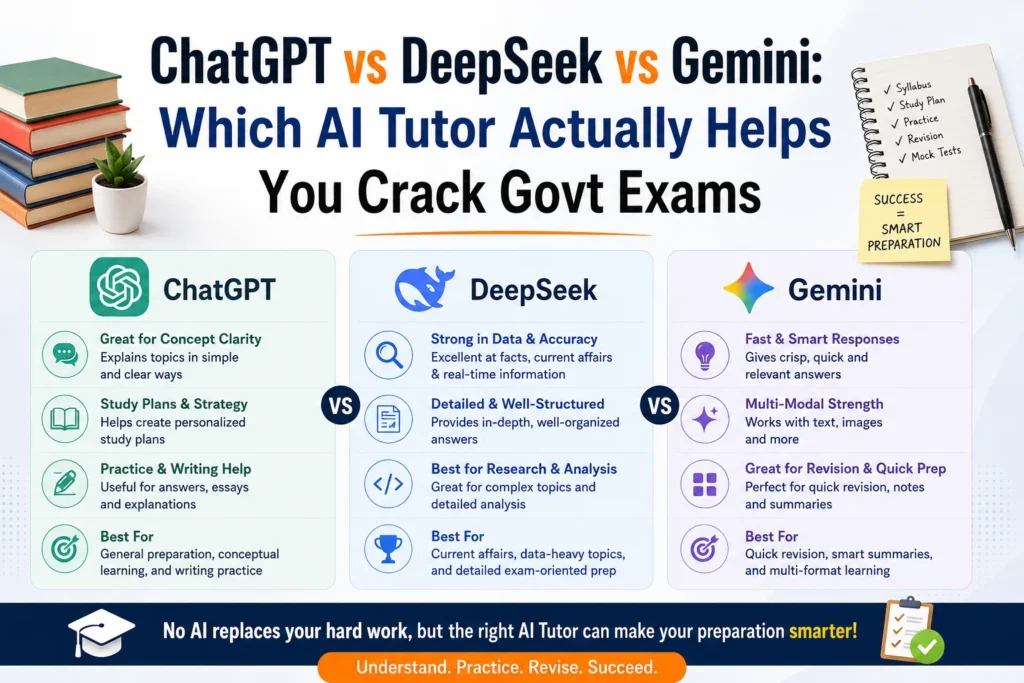
The Final Verdict — By Exam
For SSC, Bank PO/Clerk, Railways (quant + reasoning heavy, high volume of MCQs): Go with DeepSeek. You need speed and volume more than you need beautiful prose, and the cost difference is not trivial when you’re solving 200+ questions a day across months of prep. Its free web chat alone can replace a chunk of what you’d otherwise pay a doubt-solving app for.
For UPSC Mains, State PSC Mains, and any exam with a substantial written/essay component: Go with Gemini. The essay test wasn’t close — it wrote the most defensible, examiner-friendly answer of the three, and its 1M-token context window means you can paste your entire notes, a full PYQ compilation, or your own answer for critique in one go without truncation.
For a single all-rounder if you can only afford one subscription and want a mix of teaching + practice: Go with ChatGPT. It’s not the best at any single category, but it’s the most consistently “good enough” across quant, reasoning, and essays, and its explanatory style suits someone learning a concept for the first time rather than drilling an already-known one.
The honest bottom line: no single AI is your tutor. All three will occasionally get facts wrong, especially on India-specific static GK, recent policy names, or exact scheme figures — verify anything numeric or fact-based against your standard reference books (Lucent, NCERT, PIB) before it goes into an answer sheet. Use DeepSeek to grind volume cheaply, Gemini to sharpen your Mains-level writing, and ChatGPT if you want one tool that’s decent at everything and you don’t want to juggle three tabs. And regardless of which one you pick, don’t let any of them write your final answer for you — the exam is testing whether you can do this under time pressure, not whether an AI can.