
How AI Can Impact Your Competitive Preparation: It’s 11 PM. You’re staring at the same page of notes you’ve read three times. Your syllabus feels like an ocean, your mock test score hasn’t moved in weeks, and a quiet voice keeps asking: am I even studying the right way?
If that sounds familiar, you’re not alone. Every year, lakhs of students preparing for UPSC, CAT, GMAT, GRE, JEE, NEET, or Banking/SSC exams feel this exact mix of anxiety and overwhelm. The syllabus is massive. The competition is fierce. And “study harder” only takes you so far.
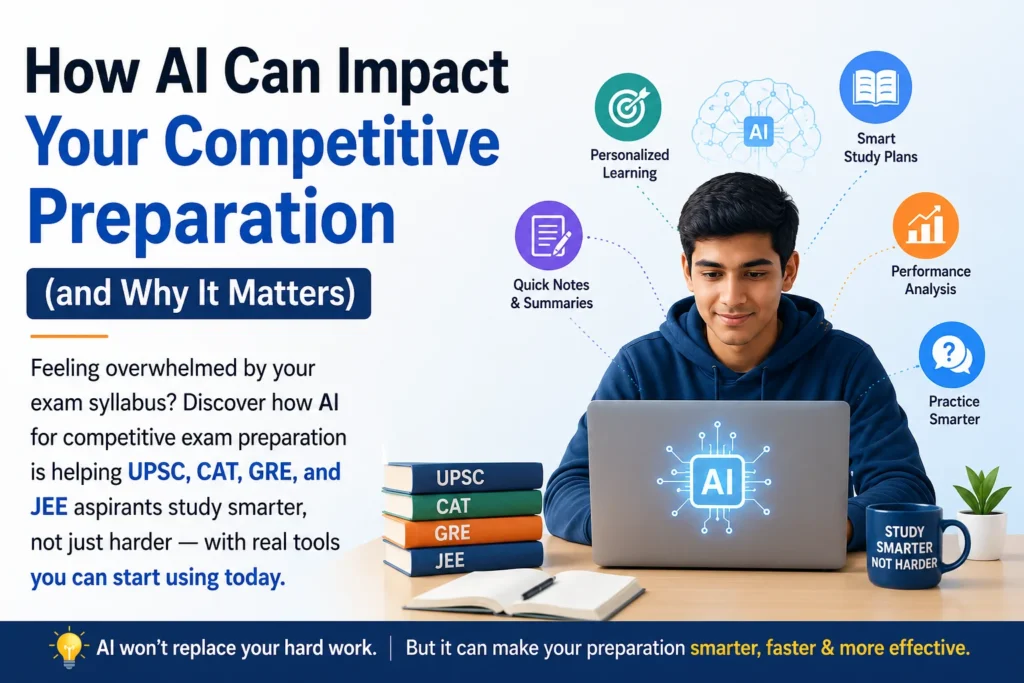
Here’s the good news: the game has quietly changed. Preparation is no longer just about how many hours you put in — it’s about how intelligently those hours are used. This is where AI for competitive exam preparation comes in.
AI won’t write your answers or take your exam for you. But it can act like a tireless personal assistant — one that never gets tired of your questions, never judges you for asking the same doubt twice, and can spot your weak areas faster than you can.
This article breaks down exactly how AI is reshaping exam prep, which tools are actually worth your time, where AI falls short, and how to build it into your daily routine — without losing the discipline that ultimately gets you across the finish line.
Also Read: How to Clear IBPS and SBI Clerk Exams Using AI (Without Buying Paid Batches)?
5 Ways AI is Changing the Game (The Core Benefits)
Check Details below:
1. Hyper-Personalized Learning Paths
No two students have the same strengths. Yet traditional coaching often follows a one-size-fits-all timetable — same pace, same sequence, for everyone in the batch.
Personalized learning with AI flips this model. Modern AI-powered platforms study your performance data — every quiz, every mock test, every topic you re-read twice — and quietly build a learning path just for you.
- If you’re strong in Genetics but weak in Human Physiology, the system feeds you more Physiology questions automatically.
- If your CAT quant score is dragging you down while verbal is solid, your daily practice set shifts accordingly.
- Revision schedules adapt in real time instead of following a rigid, generic calendar.
Key takeaway: AI doesn’t just show you content — it shows you your content, based on your gaps.
2. Instant Doubt Clearing with GenAI
Remember waiting days for a teacher to reply to a WhatsApp doubt? That bottleneck is disappearing.
Generative AI tools like ChatGPT, Google Gemini, and Claude can now:
- Explain a tricky Organic Chemistry reaction in three different ways until it clicks
- Break down a GRE geometry problem step-by-step
- Simplify a dense UPSC editorial into exam-relevant bullet points
The explanations aren’t always perfect — but they’re fast enough to keep your momentum going, and that momentum matters more than most students realize. A doubt solved in two minutes keeps you in your study flow; a doubt left hanging for two days often kills an entire study session.
Bold takeaway: Speed of clarity, not just accuracy, is what protects your daily study rhythm.
3. Predictive Analysis & Weakness Detection
This might be the single most underrated benefit of AI mock test analysis.
Instead of just showing you a score out of 100, AI-driven analytics dig into why you scored what you scored:
- Which specific sub-topic is pulling your rank down (not just “Physics is weak,” but “Rotational Mechanics is weak”)
- Whether your errors come from conceptual gaps, calculation mistakes, or time pressure
- How your performance trend compares to your own past attempts — not just an anonymous topper
Some platforms even predict your probable percentile range based on current mock trends, so you know exactly how much ground you still need to cover.
Key takeaway: You stop guessing what to revise next. The data tells you.
4. Time Management & Smart Scheduling
Ask any successful aspirant what they’d change about their early preparation, and most will say: “I wish I’d managed my time better.”
A good study planner AI solves this by:
- Auto-adjusting your revision calendar when you fall behind (instead of guilt-tripping you with a broken schedule)
- Balancing new topics with spaced repetition, so nothing gets forgotten
- Sending smart reminders based on your actual study patterns, not a generic 6 AM alarm
Think of it as a planner that adapts to your real life — including the days you’re sick, distracted, or simply behind.
5. Mental Wellness & AI Chatbots
Competitive exam prep isn’t just intellectually demanding — it’s emotionally brutal. Burnout, anxiety, and isolation are common, especially during long preparation cycles like UPSC or CAT.
AI-powered wellness chatbots are increasingly being used to:
- Offer quick breathing or grounding exercises during panic moments before mocks
- Track mood patterns alongside study patterns (a sudden score dip often correlates with poor sleep or stress)
- Provide a judgment-free space to vent when you don’t want to burden family or friends
Important note: These tools support emotional wellbeing — they are not a replacement for a counselor or therapist if you’re dealing with serious anxiety or burnout. If that’s you, please talk to a mental health professional alongside anything technology can offer.
The Top AI Tools You Need to Know in 2026
Here’s a practical shortlist of tools genuinely useful for exam prep right now — not hype, just utility.
- ChatGPT / Google Gemini — Best for concept explanations, generating custom practice questions, and breaking down complex topics in simple language. Gemini’s integration with search makes it strong for real-time, fact-checked answers.
- Perplexity — Useful as a research and current-affairs tool since it cites its sources, which matters a lot for UPSC and GMAT/GRE essay prep where accuracy counts.
- Photomath — A go-to for step-by-step math solutions, especially useful for JEE, CAT quant, and GRE quant sections.
- Quizlet (AI-powered flashcards) — Great for last-minute revision of formulas, vocabulary, and facts, with spaced-repetition built in.
- Adaptive test-series platforms (e.g., Unacademy, Toppr, Gradeup-style tools) — These use AI to generate adaptive mock tests and detailed performance analytics tailored to JEE, NEET, UPSC, and banking exams.
- AI-powered study planners — Apps that combine your syllabus, mock scores, and available time into a single, auto-adjusting revision calendar.
Pro tip: Don’t try to use all six at once. Pick one for doubt-solving, one for mock analysis, and one for scheduling — that’s usually enough.
The Dark Side: Limitations of AI in Preparation
This is the part most “AI hype” articles skip — but it’s exactly what separates smart students from over-reliant ones.
- AI can be confidently wrong. GenAI tools occasionally produce inaccurate explanations, especially in nuanced subjects like Indian polity, ethics, or advanced organic chemistry. Always cross-check against your standard textbooks.
- It cannot replace deep, effortful thinking. Struggling with a hard problem before asking AI for help is often where real learning happens. Outsourcing that struggle too early weakens long-term retention.
- Over-personalization can create blind spots. If an algorithm only feeds you what it thinks you need, you may miss the broader syllabus context that human teachers naturally provide.
- It doesn’t understand exam-specific nuance perfectly. UPSC Mains answer-writing style, CAT’s specific trap-question patterns, or NEET’s exact difficulty calibration — these come from experience, not just data.
- Screen fatigue is real. More AI tools often means more screen time, which can hurt focus and sleep if not managed carefully.
How to Integrate AI into Your Daily Study Routine (Actionable Steps)
You don’t need a complicated system. Start small and build from there.
- Morning (15 minutes): Ask your AI study planner to review yesterday’s performance and suggest today’s top 3 priority topics.
- Study block (2–3 hours): Study a topic the traditional way first — textbook, notes, standard sources. Only use AI to clarify doubts you genuinely get stuck on.
- Practice (30–45 minutes): Generate a topic-specific mock quiz using AI (e.g., “Create 20 NEET-level MCQs on Human Reproduction, increasing in difficulty”).
- Evening review (20 minutes): Run your mock test results through an AI analysis tool to identify exactly which sub-topics need re-revision tomorrow.
- Weekly reset (Sunday): Ask your AI planner to rebalance your schedule based on the week’s actual progress, not the original plan.
Key takeaway: Use AI to bookend your study session — for planning and review — while keeping the core learning process human, effortful, and focused.
Myth vs. Fact: Clearing the Confusion Around AI in Exam Prep
Myth: AI will make coaching centers and teachers irrelevant. Fact: AI is excellent at data analysis and repetitive doubt-solving, but human teachers still excel at motivation, exam strategy, and nuanced answer-writing feedback — especially for subjective exams like UPSC Mains.
Myth: Using AI is “cheating” or makes you lazy. Fact: Using AI to identify weak areas or generate practice questions is no different from using a good textbook or test series — it’s a tool, and how you use it determines the outcome.
Myth: AI tools are too expensive for most students. Fact: Many of the most useful tools (ChatGPT free tier, Gemini, Quizlet, Photomath) offer strong free versions that cover 80% of what a student actually needs.
Myth: AI-generated mock tests are as reliable as official exam patterns. Fact: AI-generated questions are useful for practice and concept reinforcement, but they should supplement — not replace — official test series like NTA Abhyas or previous years’ papers.
The Future: Will AI Replace Coaching Centers?
Short answer: not entirely — but it will reshape them.
The coaching model of the future is likely to be hybrid: AI handles the repetitive, data-heavy work — mock generation, performance tracking, doubt-clearing at scale — while human mentors focus on what they do best: strategy, motivation, nuanced feedback, and the accountability that keeps students showing up on hard days.
Toppers increasingly describe their preparation as “AI efficiency plus human guidance” — using AI tools for quick revision and instant doubt-solving, while relying on experienced teachers for exam-oriented strategy and real answer-writing feedback. That combination, not AI alone, is what tends to produce consistent results.
Coaching centers that adapt by integrating AI-powered analytics into their teaching will likely thrive. Those that ignore the shift may struggle to keep up with student expectations.
Conclusion: Embrace the Tech, But Keep the Discipline
AI is not a shortcut to clearing UPSC, CAT, GMAT, GRE, JEE, or NEET. No app can sit for your exam or build your discipline for you.
But used well, AI for competitive exam preparation can save you hours of guesswork, show you exactly where to focus, and keep you company during the hardest, loneliest parts of your prep journey.
The students who will have an edge in the years ahead aren’t the ones who study the most hours — they’re the ones who combine consistent, disciplined effort with smart, personalized tools. Start small. Pick one AI tool. Use it for a week. Then build from there.
Your syllabus isn’t getting any smaller — but with the right tools, your path through it can get a lot clearer.
Frequently Asked Questions
Q1. Is AI actually useful for UPSC preparation, or just for technical exams like JEE?
Yes. AI is useful across the board — for UPSC, it helps with current affairs summarization, answer structuring practice, and quick concept clarification, in addition to technical subjects like JEE and NEET.
Q2. Which AI tool is best for beginners preparing for competitive exams?
Start with a free, general-purpose tool like ChatGPT or Google Gemini for doubt-clearing, then add a dedicated study planner or mock-analysis tool once your routine is established.
Q3. Can AI predict my exam score accurately?
AI can estimate a probable score or percentile range based on your mock test trends, but it cannot predict your actual result with certainty — treat these predictions as guidance, not guarantees.
Q4. Is it safe to rely fully on AI-generated notes instead of standard textbooks?
No. AI-generated content should supplement standard textbooks and official study material, not replace them, since AI can occasionally produce inaccurate or incomplete information.
Q5. Will AI tools work without a good internet connection?
Most GenAI and cloud-based tools require internet access, though some apps offer limited offline features like saved flashcards or downloaded practice sets.