
Artificial intelligence tools like ChatGPT-5, Claude, Gemini, and Copilot have moved from novelty to necessity in student life almost overnight. What began as a curiosity in 2023 has become a daily habit for millions of students who use these tools to brainstorm, summarize, code, and — increasingly — complete entire assignments.
For schools and colleges, this shift isn’t a passing trend to wait out. It’s a permanent change in how learning, writing, and assessment work. Institutions that treat AI as a one-time “cheating problem” to be solved and forgotten are already falling behind. The ones adapting proactively — updating their academic integrity policies, deploying AI detection tools, and rethinking assessment design — are the ones protecting the value of their degrees and diplomas.
This guide breaks down exactly how educational institutions can adapt to advanced AI models and build anti-cheating frameworks that actually work in 2026 and beyond.
Why Traditional Plagiarism Tools No Longer Work
For two decades, tools like Turnitin were built to catch one thing: copied text. They compared a student’s submission against a database of existing sources — books, journals, previously submitted papers — and flagged matches.
Generative AI breaks this model entirely. Tools like ChatGPT-5 and Claude don’t copy text from a database. They generate original sentences, word by word, based on patterns learned during training. There is no source to match against, which means traditional similarity-checking software is functionally blind to AI-written content.
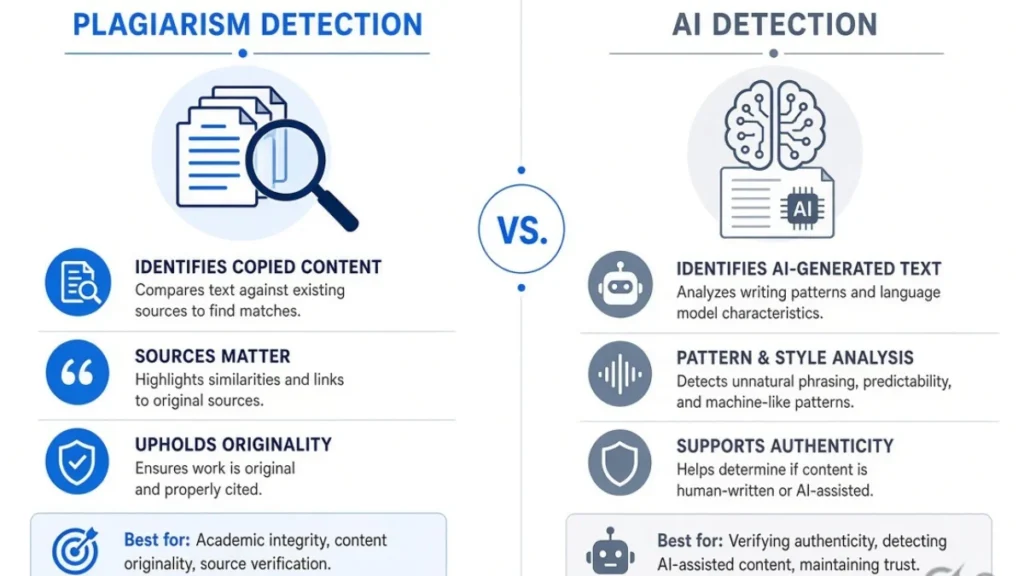
This is the core reason schools and colleges need a different category of tool: AI content detectors, not plagiarism checkers.
Key differences between plagiarism detection and AI detection
| Factor | Plagiarism Detection | AI Detection |
|---|---|---|
| What it checks | Text similarity to existing sources | Statistical writing patterns typical of AI models |
| Database dependency | Yes — needs a source to match | No — analyzes the text itself |
| Effectiveness on AI-generated text | Very low | Moderate to high (but not perfect) |
| False positive risk | Low | Moderate — a known limitation |
How ChatGPT-5, Claude, and Other AI Models Are Changing Student Work
Newer models bring capabilities that make detection and policy design harder — and more urgent:
- More natural, human-like phrasing — reducing the robotic tone older detectors relied on to flag AI text.
- Better reasoning and citation formatting — making AI-assisted essays, lab reports, and code submissions harder to distinguish from genuine student work.
- Multimodal input — students can photograph handwritten notes or textbook pages and get AI-generated answers instantly.
- Personalization and “humanizing” tools — a growing ecosystem of apps exists specifically to rewrite AI text so it evades detectors.
This arms race between AI writing tools and AI detection tools is exactly why static, one-time policies fail. Institutions need a layered, evolving strategy.
The Case for AI Detection Tools in Schools and Colleges
Despite their limitations, AI detection tools remain a valuable layer of defense when used correctly — not as the sole judge of academic dishonesty, but as one signal among several.
Benefits of adopting AI detection tools
- Early identification of at-risk submissions — flags work that warrants a closer look or a conversation with the student.
- Deterrence effect — students are less likely to submit fully AI-generated work when they know detection tools are in use.
- Data for policy refinement — detection trends help departments understand where AI misuse is most common (e.g., take-home essays vs. in-class exams).
- Support for faculty judgment — gives instructors evidence to start a conversation, not just a verdict to enforce.
Limitations institutions must acknowledge
- False positives can wrongly flag non-native English speakers or students with formulaic writing styles.
- False negatives are common against lightly edited or “humanized” AI text.
- No detector is 100% accurate — vendors themselves generally recommend against using detection scores as sole evidence for disciplinary action.
Because of this, most academic integrity offices now recommend combining detection software with human review, oral defenses, and process-based evidence like document version history.
Also Read: Passed Madhyamik or HS? 5 ITI & Polytechnic Trade Courses That Lead to Instant Technical Jobs
Building a Modern Anti-Cheating Policy: What Actually Works
Adapting to AI isn’t just about buying detection software. It’s about rebuilding academic integrity policy around a new reality. Here’s what effective institutions are doing.
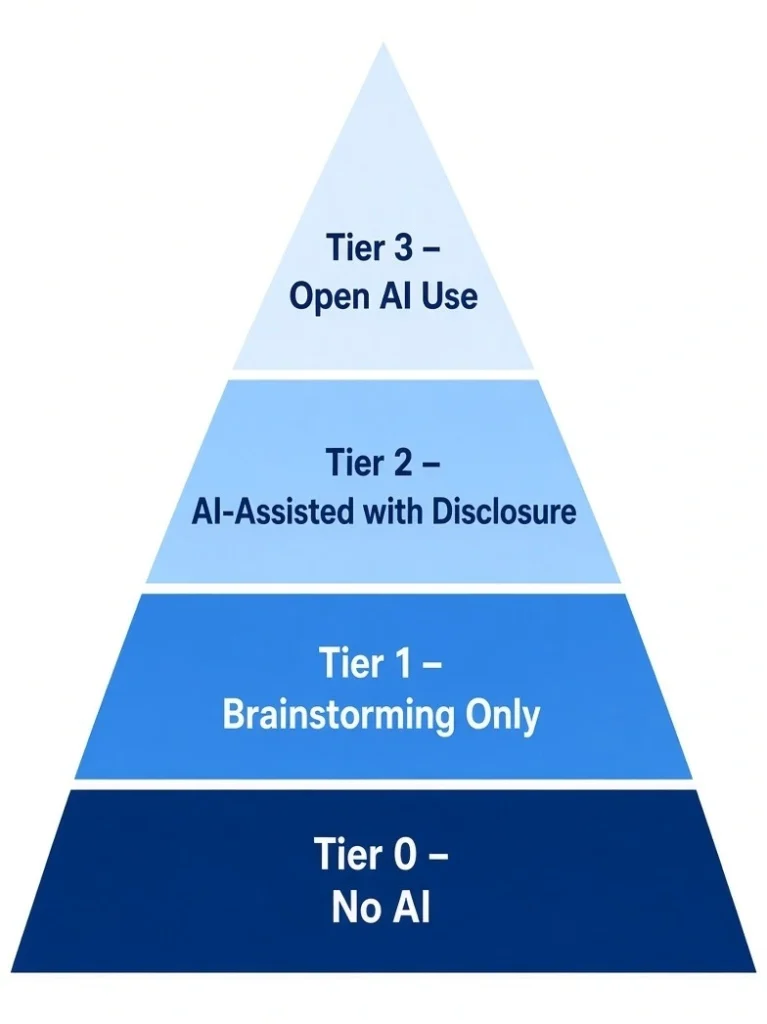
1. Define AI use tiers instead of a blanket ban
A simple “no AI allowed” rule is nearly impossible to enforce and out of step with how students will use AI in their careers. Leading institutions now define tiered permission levels per assignment:

- Tier 0 — No AI: Closed-book exams, in-class writing, oral assessments.
- Tier 1 — AI for brainstorming only: Students may use AI to generate ideas but must write final work independently.
- Tier 2 — AI-assisted with disclosure: Students may use AI for drafting or editing but must cite and explain how it was used.
- Tier 3 — Open AI use: Assignments explicitly designed around AI collaboration, with evaluation focused on critical use, not raw output.
2. Redesign assessments to be AI-resistant by nature
Instead of relying solely on detection, forward-thinking educators are shifting toward assessment formats that are inherently harder to outsource to AI:
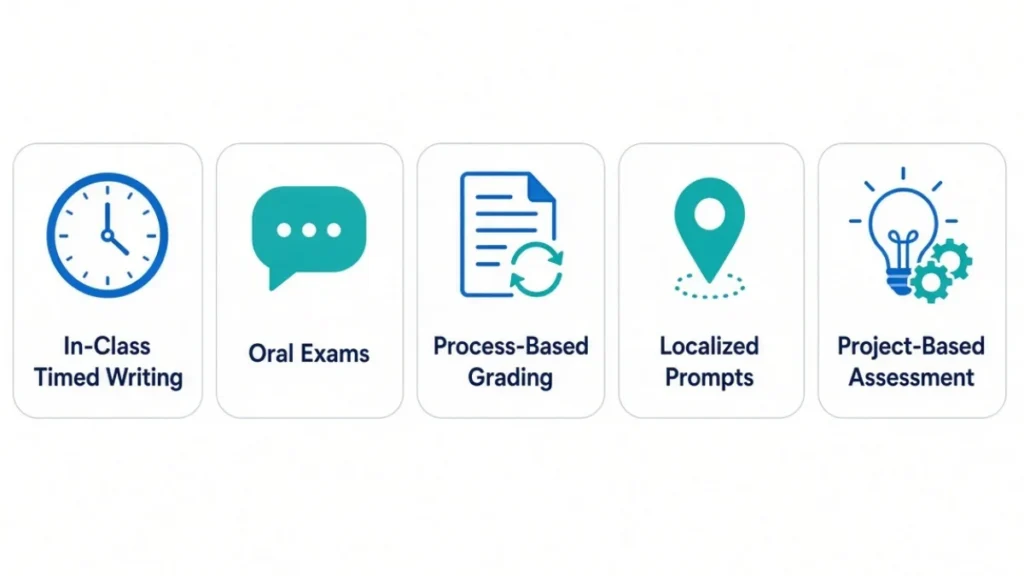
- In-class writing and timed assessments
- Oral exams and viva-voce defenses of written work
- Process-based grading (outlines, drafts, revision history via Google Docs or similar)
- Personalized or localized prompts tied to in-class discussion
- Project-based and applied assessments over generic essay prompts
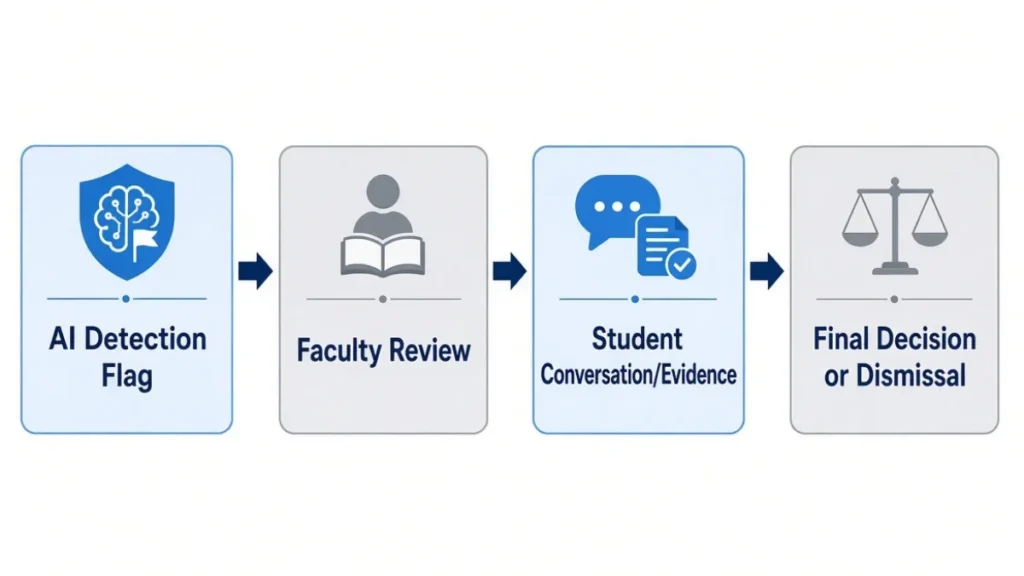
3. Use detection tools as one input, not the final verdict
Best practice policy language typically states that AI detection scores may prompt further review but are not, by themselves, sufficient grounds for a violation finding. This protects both the institution and students from the real risk of false positives.
4. Teach AI literacy alongside enforcement
Punishment without education creates a cat-and-mouse dynamic. Institutions seeing the best outcomes pair policy enforcement with instruction on:
- What ethical AI use looks like in academic and professional contexts
- How to cite AI assistance properly
- Why over-reliance on AI undermines learning outcomes even when it’s technically permitted
5. Create a clear, consistent reporting and appeals process
Because AI detection isn’t infallible, students need a transparent path to explain or contest a flagged submission — through writing samples, version history, or a conversation with faculty — before any formal consequence is applied.
Comparing Popular AI Detection Tools for Education
While Claude does not build or endorse specific detection products, most institutions evaluating AI detection software should weigh these factors:
- Accuracy across different writing styles and non-native English text
- Integration with existing LMS platforms (Canvas, Moodle, Blackboard)
- Transparency about false positive/negative rates
- Data privacy compliance (FERPA in the U.S., GDPR in the EU, and equivalent regional laws)
- Vendor guidance on appropriate use (i.e., whether they explicitly warn against sole reliance on their score)
Institutions are encouraged to pilot any tool on a sample set of known human-written and known AI-written text before full deployment, and to revisit that evaluation periodically as both AI models and detectors keep evolving.
Why This Adaptation Matters for the Future of Education
Schools and colleges that treat AI adaptation seriously gain several long-term advantages:
- Protects academic credibility — degrees retain their value when institutions can credibly certify that students met learning outcomes.
- Prepares students for AI-integrated careers — most professional fields now expect AI fluency, so blanket bans undercut workforce readiness.
- Reduces faculty burnout — clear policy and reliable tooling reduce the ambiguity and case-by-case guesswork that exhausts instructors.
- Builds trust with students and parents — transparent, fair policies reduce disputes and reputational risk.
Also Read: ITI vs Degree: Which Path Leads to a Job Faster?
Frequently Asked Questions
Can AI detection tools reliably catch ChatGPT-5 or Claude-generated text?
No tool guarantees perfect accuracy. Detection tools can flag likely AI-generated text with reasonable confidence, but both false positives and false negatives occur, especially with edited or “humanized” AI text. They should be used as one signal, not definitive proof.
Should colleges ban AI tools entirely?
Most academic integrity experts recommend against outright bans, since they are difficult to enforce and don’t reflect how AI is used in professional life. Tiered-use policies tend to be more effective and realistic.
What’s the difference between plagiarism and unauthorized AI use?
Plagiarism involves presenting someone else’s existing work as your own. Unauthorized AI use involves submitting AI-generated content as original student work in violation of a specific assignment’s stated policy — a distinct but related integrity issue.
How can teachers detect AI use without relying only on software?
Version history review, in-person discussion of the submitted work, comparing writing style to past submissions, and requiring drafts or outlines are all effective non-software methods.