
Def-Space Autumn Internship 2026: If you are an engineering student in India and your college notice board, WhatsApp group or LinkedIn feed has been buzzing about a “Def-Space” internship in drones, aircraft design and robotics, this is probably the one you saw.
The Bharat Space Education Research Centre (BSERC), New Delhi, has announced the Def-Space Autumn Internship 2026, a six-week online training-and-project programme starting 9 October 2026. Registration closes on 5 October 2026, there are 750 seats, and the registration fee is ₹950.
This article walks through everything in the official notice in plain language — the schedule, the fee structure, who can apply, what the certificate actually is — and then, just as importantly, the questions you should ask before you pay. Not because there is anything proven wrong with the programme, but because paid “internships” are a crowded space in India right now, and a good decision needs both halves of the picture.
Quick summary: Def-Space Autumn Internship 2026 at a glance
| Detail | Information (as stated in the official notice) |
|---|---|
| Programme name | Bharat Def-Space Autumn Internship 2026 |
| Organiser | Bharat Space Education Research Centre (BSERC), New Delhi |
| Mode | Fully online |
| Duration | 6 weeks (the notice also states 45 days) |
| Training start | 9 October 2026 |
| Certification & evaluation | 22 November 2026 |
| Total seats | 750 |
| Registration fee | ₹950 (non-refundable) |
| Additional training/internship fee | None, per the notice |
| Stipend | None |
| Last date to register | 5 October 2026 |
| Session timing | 5:00 PM onwards (IST) |
| Registration portal | internship.bserc.org |
| Certificate | Internship completion certificate on completion |
What the Def-Space Autumn Internship 2026 actually is
BSERC describes the programme as a flagship six-week intensive online internship under what it calls the Def-Space Education and Innovation initiative. The notice positions it against the backdrop of India’s space-sector reforms since 2020, the Viksit Bharat @2047 vision, the Atmanirbhar Bharat push for technological self-reliance, and National Space Day on 23 August.
Stripped of the framing language, here is the practical shape of it:
- Four short technology modules, each delivered over a three-day weekend block
- A two-week self-directed project phase
- A final evaluation and certification date
It is a structured online short course with a capstone project, delivered live in the evening so that it does not clash with college hours. That is a reasonable format for a first exposure to a field. It is not a lab placement, a research assistantship, or a company internship with a supervisor and deliverables — and it is worth being clear-eyed about that distinction when you describe it later on a CV or in an interview.
Also Read: National Horticulture NHB Internship 2026
Full schedule and syllabus
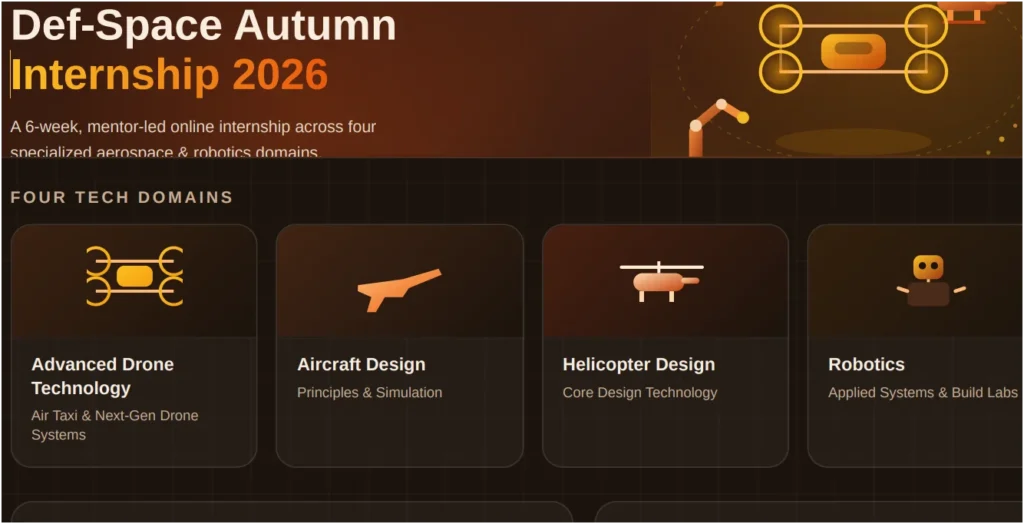
The Def-Space Autumn Internship 2026 coursework is organised into four technology domains, each running Friday to Sunday, followed by the project window.
| Module | Dates (2026) | Timing |
|---|---|---|
| Aircraft Design Technology | 9 October – 11 October | 5:00 PM onwards |
| Advanced Drone Technology | 16 October – 18 October | 5:00 PM onwards |
| Helicopter Design Technology | 23 October – 25 October | 5:00 PM onwards |
| Robotics | 30 October – 1 November | 5:00 PM onwards |
| Project work | 2 November – 15 November | Self-paced |
| Certification and evaluation | 22 November | — |
What each module is likely to cover
The notice lists module names without a detailed syllabus. Based on how BSERC has described similar Def-Space modules in its earlier summer and winter batches, you can reasonably expect introductory-level coverage along these lines — but treat this as an expectation, not a promise, and ask the organiser for the detailed syllabus before paying:
Aircraft Design Technology — basics of aerodynamics, lift and drag, airfoil selection, wing loading, and an introduction to conceptual design workflows and simulation tools.
Advanced Drone Technology — UAV classifications and frame types, propulsion and battery sizing, flight controllers, an overview of India’s Drone Rules and the DigitalSky framework, and civil and defence applications including the air-taxi and eVTOL direction.
Helicopter Design Technology — rotary-wing fundamentals, main and tail rotor function, hover and forward flight, autorotation, and where rotorcraft sit alongside fixed-wing platforms.
Robotics — sensors and actuators, microcontroller basics, control loops, and a simple build-or-simulate exercise.
Project phase — a two-week window to apply one of the modules to a small individual or team project, which is then submitted for evaluation.
Four evening weekends is roughly 24 to 36 contact hours in total. That is enough to build orientation and vocabulary across four fields. It is not enough to make anyone job-ready in any one of them, and no honest programme of this length would claim otherwise.
Also Read: IUCAA INAT 2027 Notification Out
Eligibility: who can apply
The notice is unusually open on eligibility. It lists:
- Everyone — stated as the first line of the eligibility list
- Undergraduate students — B.Tech and equivalent programmes
- Postgraduate students and researchers — M.Tech, MSc, PhD and related fields
- Working professionals — with a strong interest in space and defence technologies
Students from all streams of Science, Engineering, Mathematics and Technology are encouraged to apply.
One point worth flagging honestly: the brochure says the programme is “designed to identify and nurture high-potential talent,” and the BSERC website for the autumn batch refers to merit-based selection through an examination. The brochure itself lists no examination date, no result date and no selection criteria for the autumn batch, and simultaneously says “Everyone” can apply. If selection matters to you — for instance, if you want to be able to say on a CV that you were selected from a competitive pool — write to info@bserc.org and ask directly whether there is a selection test for this batch, and what the selection ratio is.
Fees, stipend and what your ₹950 buys
This is the part students should read twice.
- Registration fee: ₹950, non-refundable. If you register and then cannot attend, or the schedule shifts, the notice does not provide for a refund.
- Training and internship fee: none. Per the notice, there is no second payment after registration.
- Stipend: none. This is a paid-by-you learning programme, not a paid internship.
Eight things to verify before you pay ₹950
Do these before 5 October, not after.
- Confirm the legal entity. Ask for the registered name, registration type (society, trust, Section 8 company or private limited) and registration number. Any real training body will tell you.
- Ask for the detailed syllabus and mentor list. Names, current affiliations, LinkedIn profiles. “50+ mentors” is a number; a named mentor with a verifiable background is a credential.
- Ask what the certificate says. Does it say “internship completion” or “training completion”? Is the issuing entity BSERC alone, or is any government body co-branded? Get this in writing.
- Ask about session recordings. If you miss a Saturday evening, do you get access?
- Check whether a placement or career claim is being made. Phrases like “career pathways in ISRO, DRDO, HAL” describe sectors, not placements. Ask explicitly whether any placement assistance is included. Almost certainly it is not.
- Pay only through the official domain. Registration should happen on internship.bserc.org or bserc.org. Never pay to a personal UPI ID, a WhatsApp number or a Google Form linked from a forwarded message. Screenshot the payment and keep the receipt.
- Ask about the selection test. As noted above, the brochure and the website differ on this point.
- Talk to a past participant. Search for someone who posted about the summer or winter 2026 batch on LinkedIn and message them. Ten minutes of this is worth more than ten brochures.
Free and low-cost alternatives worth comparing
Before spending ₹950, it is worth knowing what exists at zero cost, because a student applying to ISRO or DRDO later will find these carry more weight:
- ISRO’s IIRS outreach programme runs free online courses in remote sensing and geoinformatics with certificates, open to students through registered institutions.
- ISRO START (Space Science and Technology Awareness Training) offers free introductory space-science lectures by working ISRO scientists.
- IIST and ISRO centre internships are competitive, unpaid or stipended, and carry genuine institutional weight.
- DRDO internships are applied for directly through individual laboratories.
- NPTEL and SWAYAM offer full-semester courses in aerodynamics, control systems and robotics from IIT faculty, free to audit, with a paid proctored exam only if you want the credential.
- Student bodies — IEEE, SAE India’s Aero Design and Baja competitions, and college aeromodelling clubs — give you hands-on build experience, which is what interviewers actually probe.
A ₹950 short course and these are not mutually exclusive. But if your budget or your time is limited, start with the free options that carry institutional recognition.
How to register for the Def-Space Autumn Internship 2026
- Visit internship.bserc.org (or bserc.org and navigate to the autumn internship page).
- Open the Def-Space Autumn Internship 2026 registration form.
- Fill in your personal, academic and institutional details.
- Pay the ₹950 registration fee through the official payment gateway on the site.
- Save the confirmation email, transaction ID and receipt.
- Watch your email and spam folder for joining details before 9 October.
- Register on or before 5 October 2026.
For queries, the notice lists info@bserc.org and +91 7303048646.
Should you apply? An honest assessment
This programme may suit you if: you are a first- or second-year student with no exposure to aerospace subjects, you want a structured push to finally build a small drone or robotics project, ₹950 is not a meaningful amount for you, and you understand you are buying a short course rather than an internship in the traditional sense.
Look elsewhere if: you need a stipend, you need a credential that will impress an ISRO or DRDO selection panel, you are already past the introductory stage in these subjects, or you cannot reliably attend four consecutive weekend evenings in October.
The single most valuable output of Def-Space Autumn Internship 2026 like this is not the certificate. It is the project. If you do apply, treat the two-week project window in November seriously, push it beyond the minimum required for evaluation, publish it on GitHub with a clear README and a short demo video, and write about it on LinkedIn. A certificate is a line on a CV. A working project you can explain for ten minutes is what actually gets you the next opportunity.
Frequently asked questions
Is the Def-Space Autumn Internship 2026 a government internship?
No. It is run by the Bharat Space Education Research Centre, which describes itself as operating in alignment with ISRO initiatives and as a registered Skill India Training Centre, but it is not ISRO, IN-SPACe, DRDO or a body under the Department of Space.
Is there a stipend?
No. The notice states clearly that no stipend is provided.
What is the total cost?
₹950, non-refundable, as a registration fee. The notice states there is no separate training or internship fee.
What is the last date to apply?
5 October 2026.
How long is the programme?
Six weeks of activity, from 9 October to the certification date of 22 November 2026. The notice also refers to 45 days.
Is it online or offline?
Fully online, with live sessions from 5:00 PM IST.
Will I get a certificate?
Yes — the notice states that interns receive an internship completion certificate after completing the programme.
Can working professionals and non-engineering students apply?
Yes. The notice lists working professionals, and students from Science, Mathematics and Technology streams, alongside B.Tech, M.Tech, MSc and PhD candidates.
Is there an entrance exam?
The brochure does not list one for the autumn batch, while the BSERC autumn internship webpage refers to merit-based selection through an examination. Confirm directly with the organiser at info@bserc.org.
Disclosure and editorial note
This article is informational and is not sponsored by, affiliated with or endorsed by BSERC. All programme details are as published in the official BSERC notice dated 30 August 2026 and on bserc.org, and are accurate as of 14 September 2026; dates, fees and seat counts can change without notice, so verify on the official site before paying. We have no commercial relationship with the organiser and receive no commission on registrations. Readers should independently verify any programme before making a payment.
Sources: BSERC official notice Ref. बी.एस.ई.आर.सी./2026/DSAI-26 dated 30 August 2026; bserc.org/about; internship.bserc.org.